

Balanced Cables Don’t Reject Noise Better and Some May Be Making Your System Worse, Says High-End Audio Engineer
https://www.headphonesty.com/2025/10/balanced-cables-more-noise-highend-audio-engineer/
Balanced connections send the same signal on two wires, with one inverted. At the receiving end, the device compares the pair and cancels the noise that affected both equally... .. balanced doesn’t automatically buy you lower noise, as good grounding, shielding, and sensible layout matter more. ... ...the biggest contributor to noise is.. the contamination on the ground path. ... . because both single-ended and balanced cables rely on a ground or shield, any interference introduced here can still couple into the audio signal. ... ..That’s why layout and grounding often matter more than connector type... RCA to XLR. ...
https://www.headphonesty.com/2025/10/balanced-cables-more-noise-highend-audio-engineer/

Interesting find. Same could be said for typical audio cables vs the ones you get at a hi fi shop where you pay $100 for a 10 ft length of RCA to RCA or TRS to RCA or what have you and signal has to go in a certain direction.
Here's some more info on balanced and unbalanced. https://www.boxcast.com/blog/balanced-vs.-unbalanced-audio-whats-the-difference
But it does make sense that proper shielding in unbalanced cables would stop longer runs from picking up noise also. Some audio cables use the shield as the shielding wrapped around the other signal carrier wire but the best are the audio cables that have foil shielding under the insulator like this...
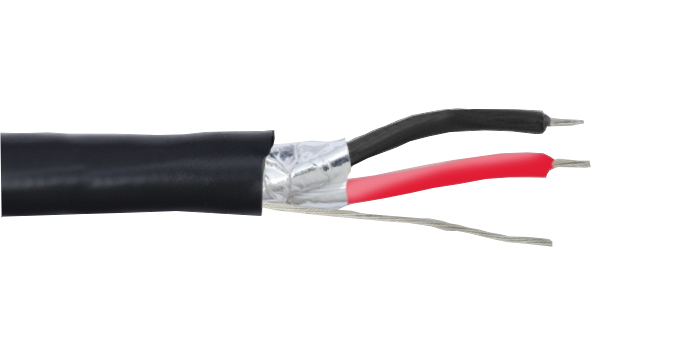
@mark Good article, I enjoyed it. The biggest takeaway is using unbalanced RCA connections are fine for runs of less than 10 feet, it doesn't make much difference, but for runs of 25 feet or more then balanced connections make all the difference in the world, especially if the audio and power cabling is are close proximity to each other (which is usually the case with part 15 installs(
So it's really a question of how long the run to your transmitter is.. it concludes that "if you have the option, we recommend using balanced cabling over unbalanced cabling whenever possible." - but as the previous article points out, that's not necessarily always the case.
@richpowers The 4 conductor shielded cable we use to get the audio and power from the indoor to a transmitter that could be 50 ft away or more does have the power and audio wires together even if foil shielded. The shielding is around all 4 wires. Balanced in this case may not be better. In the article I linked it shows how the balanced wiring configuration is with "hot" "cold" and ground or TRS(3 wires) in a cable even if mono but just thought that the connections from the terminal blocks are only 2 wires not 3 So I ask, I don't know, is the runs of cable to the transmitter a true balanced cable? The terminal block connections are just hot/ground or as indicated + audio and - audio.
@.. So I ask, I don't know, is the runs of cable to the transmitter a true balanced cable? The terminal block connections are just hot/ground or as indicated + audio and - audio.
Not that I would know, but as the first article points out..
"Balanced connections send the same signal on two wires, with one inverted. At the receiving end, the device compares the pair and cancels the noise that affected both equally."
But it also points out that non- balanced connections has its advantages:
"For Michael Børresen, the choice to favor single-ended signal paths is a deliberate engineering decision. Since he believes most noise in home setups comes from grounding rather than inter-signal bleed, he focuses on keeping circuits as simple as possible.. .. ..This isn’t a universal rule against balanced, though. If a component is fully differential end-to-end, XLR may be the native, most transparent path."
In the first article it says that regardless if your using balanced or unbalanced connections, the audio and power cables should be run separately. To me that seems a tricky objective to accomplish with part 15 xmtr installation, thus it makes it all the more important to use a balanced feed to limit potential interference. However, "...because both single-ended and balanced cables rely on a ground or shield, any interference introduced here can still couple into the audio signal.".
To a certain extent it's probably all hype, like as I think you mentioned, using gold tip connectors instead of whatever, or using an external DAC instead of your onboard PC soundcards, doing so might potentially prevent interference and insure a clean signal path, but chances are most people wouldn't be able to perceive any difference anyway, and your likely to get more interference at the receiving end that has absolutely nothing to do with any potential interference occurring with the cabling of the transmitter anyway.
So you know, I don't know, but in general, every little thing helps.. or at least can potentially be an improvement your stations signal quality.