I've been experimenting with AM on several frequencies. I know that we talk about AM antenna and transmitter efficiency being better on the X band (I've been using 1620) but I wonder how much you really lose by going down the band.
Some radios, a few that I own in fact, do not support the X band. You have a better probability of people coming upon your signal lower down in the AM band (I've also been experimenting with 1570 and 1430, although I'd like to move up to around 1480 or so as well, but haven't had the chance in the car to check out the stations around that vicinity).
I have to admit that I don't notice much difference in either listenability or signal strength (using a Tecsun PL-365) between the three.
I've used 1570 in the past years ago, and managed to get over a mile of range on my Talking Sign with the wire antenna strung outside and above the roofline of my house.
One disadvantage is that there are more stations below the X band, so at night you'll have a greater chance of being wiped out by the skywave of other stations on your frequency.
So, I'm wondering what experience do others have using lower AM frequencies. Does it really make all that much difference for a few hundred Khz? And how much?
I can answer with experience as I am using the Procaster. The Procaster goes from 1290 to 1700. The best range/best peak on the meter will be in the 1600 to 1700 range and 1670 will be better than 1620 for example. The peaking on the meter corresponds with the signal the radiates from the antenna. I am on 1630 as here in Toronto there is a station at 1610, 1650, and 1690. I could have gone to 1670 but most radios even though don't officially have the expanded band will top out at 1630. I was before on 1560 thinking that older radios can't get the expanded band....there's an Oshawa station on 1580 and having to have open spots on each side of my chosen spot 1560 is the closest I can be to stay close to the 1600s in Toronto so not too much loss in coverage. Comparing how much loss there was in the peaking of the meter and resulting range all other things being equal there was distinct loss at 1560 as compared to just 1630. And the 1400s and 1500s are the noisiest places on the band as at night many stations are cramming at once. So yes, as you go down from 1600 the loss becomes worse and going down from 1630 to...say.... 1350 or below will result in about a 50% cut in performance. So you would cover half the distance and be be much more wiped out at night. The difference from 1630 down to 1560 was about 10% and much more at night as many more stations are cluttering up the frequencies below 1600.
But if my listeners are all getting it at 1630 no need to change to 1560 and I gave a radio to one of my listeners and the other one I asked about how you are getting 1630 and he said just fine so no need to change. That other woman who I discovered was a listener the other day also was getting it so they must have radios reaching to at least that.
The verdict, if you want to stay out of the expanded band for older radios stay as high in the 1500s as you can. If you can go to 1600 or 1590 where you are located to stay out of the expanded band that is best as if you get one mile at 1630 and 4/5ths of a mile at 1570, all things being equal you have to figure the loss in coverage as an accepted sacrifice for being available on all radios, and does that small loss of range really matter?

I've mentioned before that Retro Radio 1490 in Montana uses a Procaster. Not sure if I've mentioned it's on a 50' tower otop the roof, but he bragged about 10 mile range.. but to your point,
I've pondered over the same, range is a priority, thus why I've always chose 1700, but it seems almost a sacrilege when you consider it excludes most pre-90s radios from receiving it.
Here's R. Fry's take on it at https://radiodiscussions.com/threads/part-15-am-coverage-high-vs-low-carrier-frequency.701750/
At 1650 kHz...
- Loading Coil R-F Resistance at System Resonance = 20 Ω (assumed)
- Groundwave Field Intensity at 1 mile = 84 µV/m
At 570 kHz...
- Loading Coil R-F Resistance at System Resonance = 30 Ω (assumed)
- Groundwave Field Intensity at 1 mile = 34 µV/m
More details:
For the 1650/570 kHz systems:
- Radiation resistance (R[SUB]r[/SUB]) = 0.1/0.01 Ω
- Ground Connection R-F Resistance (R[SUB]g[/SUB]) = 7/7.2 Ω
- Loading Coil R-F Resistance at System Resonance (R[SUB]c[/SUB]) = 20/30 Ω, assumed
Antenna system radiation efficiency = R[SUB]r[/SUB] / (R[SUB]r[/SUB] + R[SUB]g[/SUB] + R[SUB]c[/SUB]).
The reduced, groundwave propagation losses at 570 kHz are not able to compensate for the lower ERP that system produces.
□
There's also this interesting excerpt from https://www.angelfire.com/80s/classichits99x/antennas.htm that addresses the topic..
"Low power broadcasters and other experimenters tend to use the high-frequency end of the AM band. For any given size of antenna, efficiency will be better at high frequencies than at low frequencies.
For example, let's consider the case of an antenna 3 meters tall. The radiation resistance of this antenna will be about 0.014 ohms at 600 kHz and 0.116 ohms at 1700 kHz.
Assuming 1 ohm of resistive loss in the loading coil and a 1 ohm loss in the ground system (best case scenario), the antenna efficiency at 600 kHz will be 0.7%, but at 1700 kHz it's a whopping 5.5%.
If we're using a Part 15 transmitter with 100 milliwatts of DC input to the final stage and an amplifier efficiency of 80%, we might have as much as 80 milliwatts of RF going to the antenna.
Assuming no feedline losses and no impedance mismatch, the effective radiated power would be 0.56 milliwatts at 600 kHz, or 4.4 milliwatts at 1700 kHz. Groundwave propagation is better at the low end of the band, but not enough to counter-balance the increase in antenna efficiency that you get by using higher frequencies.
I don't think that it's always antenna efficiency that matters.
Just as some Part 15 FM transmitters appear to do better on different parts of the band, so does, at least for the Talking Sign, one AM transmitter.
Measuring the dbu/V with my Tecsun receiver, the signal is actually stronger on 1430 than on 1620 (not by much, 1 or 2 db). I realize that the absolute value of the Tecsun signal strength is meaningless, but the relative values at least show which signals are stronger.
So, I don't know. The difference in frequency between 600 Khz and 1650 Khz is significant (about 250%). The difference between 1430 and 1620 is about 12%. I can see where a comparison of signal strength measurements for the latter could be lost in potential errors. And even if you lose around 10% of your range down at 1430, assuming a mile (about 5000 feet) range at best, you lose maybe 500 feet of that.
Addendum: I chose 1430 because there was a powerful AM station that went dark about a year ago, so there are no other AM stations close to it locally. I am going to check out higher in the 1400's and the 1500's as well, but a cursory sweep showed quite a few. Unfortunately, in my location, you get both southern coast B.C. and Washington State ones.
I tend to agree that just calculationing of antenna efficiency is not going to tell the whole story when comparing performance between the two frequencies. Real world experimentation is always going to reveal the most reliable comparisons. All I know for sure is that the performance of part 15 AM tends to be unpredictable. Seemly identical installations often don't perform the same. Theory also indicates that "line of sight" has little to no effect with AM (as R. Fry often insisted), but experience indicates that when such low power is involved then line of sight plays a significant role - put a building between you with part 15 and your signal is blocked (or attuned or whatever you prefer to call it).
You have the right idea, try it and see how well it really works on a lower frequency.
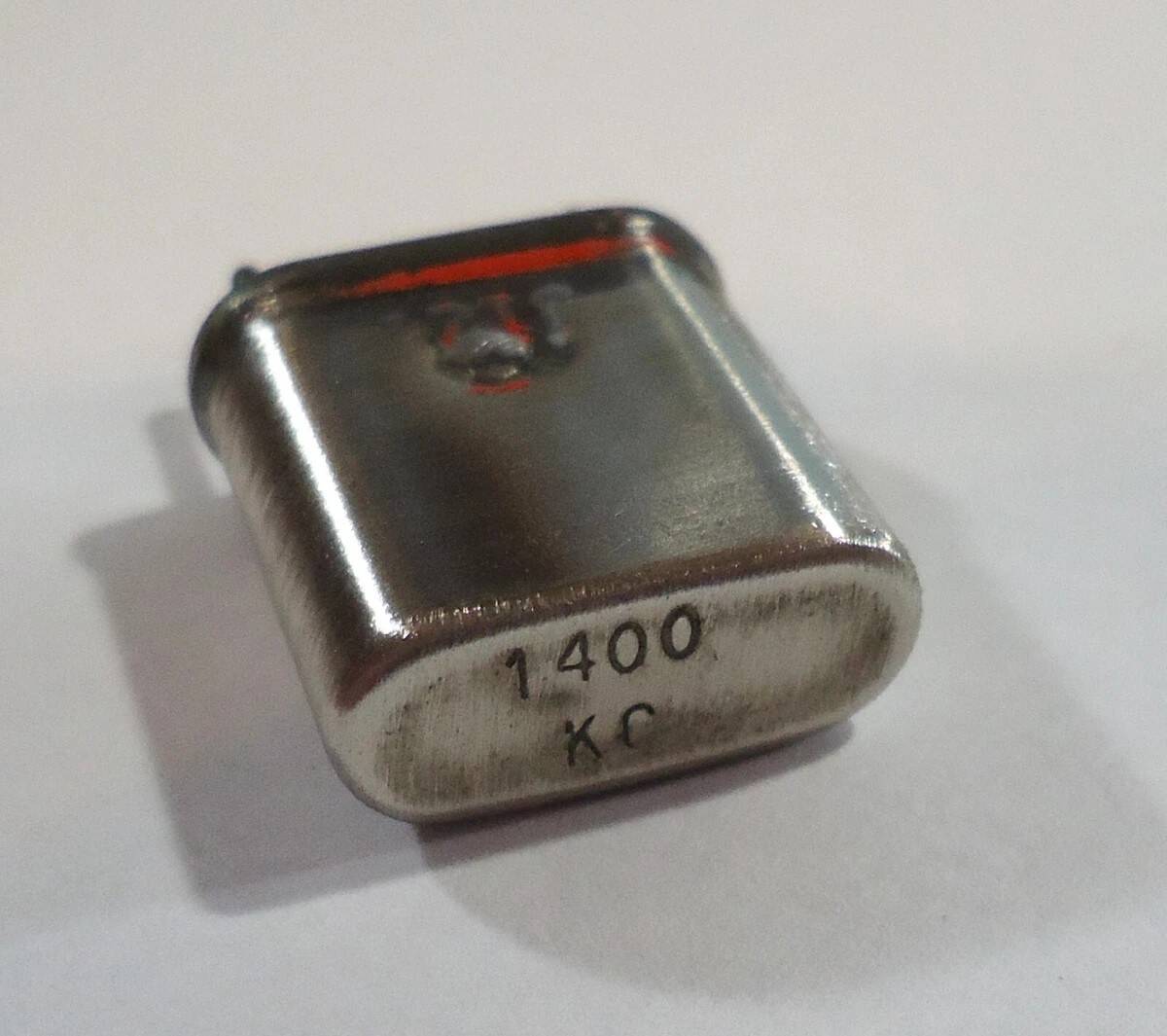
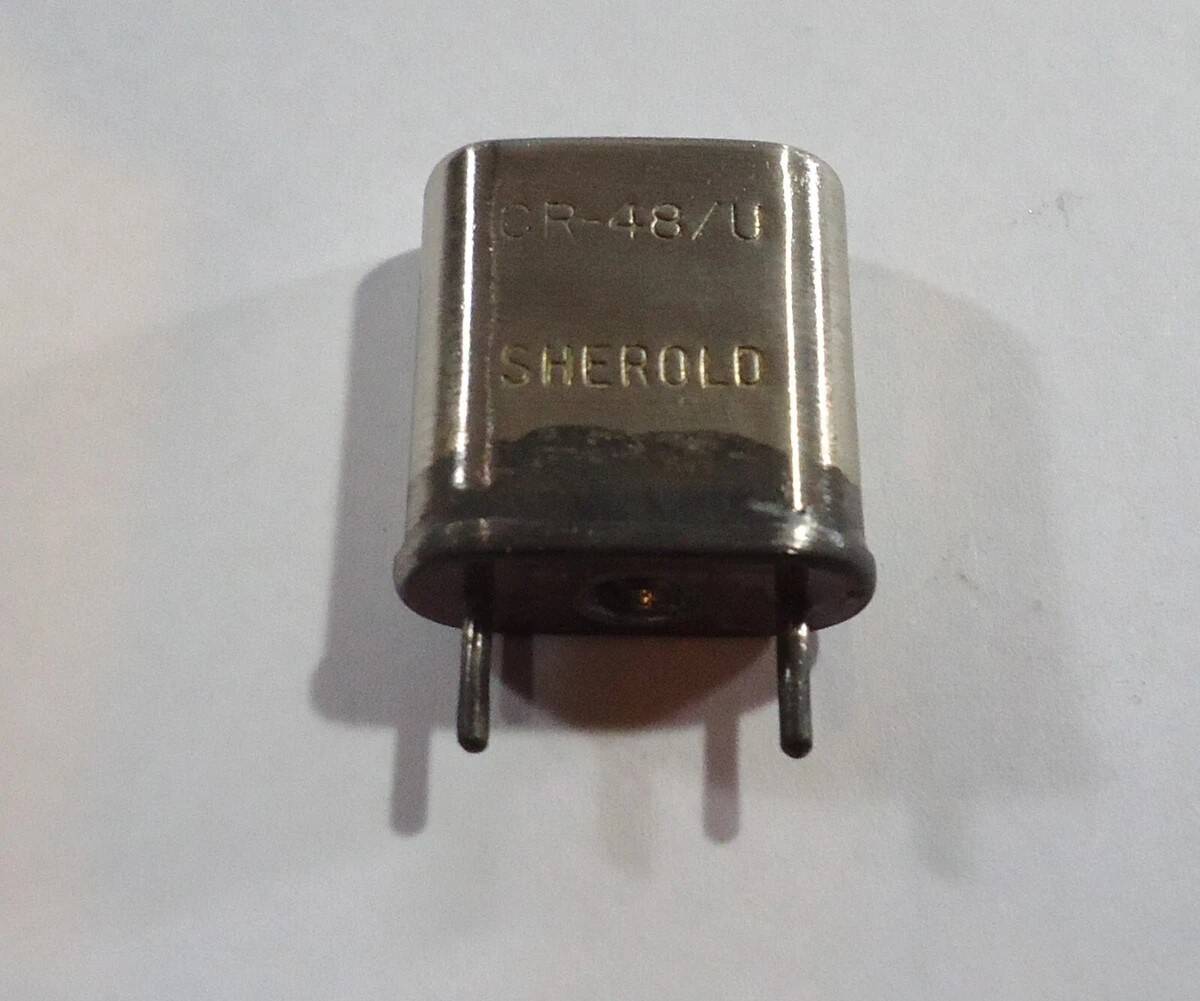
And while on the subject,. A question.. this 1400 crystal pins are a tad too big to fit in my Rangemaster.. (bought on ebay) is there a such thing as an adapter? Surely the crystal itself is compatible, right?
HC-6/U - 1400 KHz Radio Crystal - .050 Pins - Sherold - CR-48/U