

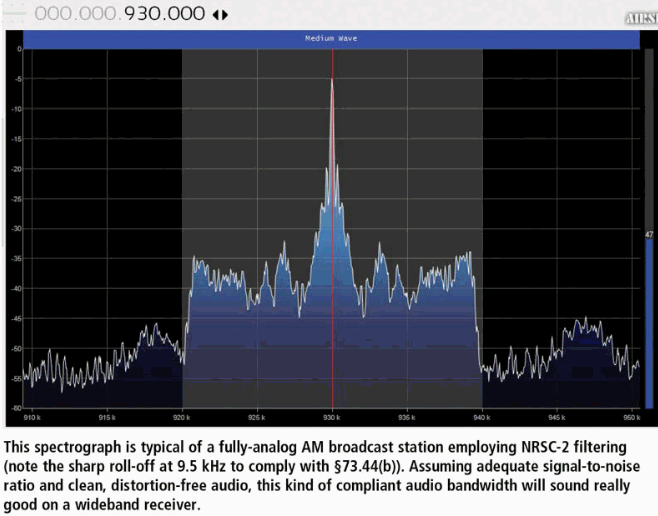
Below is a clip showing the received r-f spectrum of an AM broadcast station, at one instant of time. The carrier plus its upper and lower sidebands are clearly visible.
The two sidebands are mirror images of each other, because they are produced by a process where the audio program modulation creates sum and difference r-f spectra, referenced to the carrier frequency.
The sidebands extend to about 9.5 kHz above and below the carrier frequency. This means that an AM receiver with reasonably flat r-f/i-f bandwidth response and able to pass that complete spectrum from 920-940 kHz could have an audio output bandwidth of ~0 to ~9 kHz. Many listeners to audio of that bandwidth would find it fairly indistinguishable from the audio bandwidth received from FM broadcast stations.
(Granted, the reception of AM broadcast stations is more susceptible to atmospheric and local r-f noise, and co-/adjacent-channel interference.)
Most commercial AM receivers are not designed to receive/reproduce program audio having a 0-9.5 kHz bandwidth. But that limitation is not a function of the capabilities of amplitude modulation itself, or the useful r-f channel bandwidth permitted by the 10 kHz carrier spacing of AM broadcast stations.

Rich states: "Most commercial AM receivers are not designed to receive/reproduce program audio having a 0-9.5 kHz bandwidth."
By "commercial" AM receivers I take it we are talking about "consumer" radios.
I have here on my control desk a ROLLS HR78X AM Digital Tuner which could be defined as a "professional" half-rack size tuner, and disappointingly it does not provide control over received bandwidth. The high-end audio is very much rolled-off.
Comparing it to the TECSUN PL-310 which has 5 different selectable bandwidths, it sounds about like the 3 kHz choice.
The available BWs on the TECSUN are 6, 4, 3, 2, and 1 kHz.
Being able to listen at 5 different bandwidths demonstrates some of the experiences encountered by listeners on their various assortment of radios.
There is nothing that can be done at the transmitter to be able to sound good at all those different bandwidths.
Another huge problem is the directivity of AM signals.
For example, the local station at 550 kHz comes in perfectly if the receiver is oriented toward the east and west, but when swiveled 45-degrees the station can be totally nulled into the noise.
People put their radios in a certain location on a desk or shelf, and it's hit or miss whether the reception will be optimum.

These days many new radios (even relatively cheap ones) are DSP-based and are built for the world market. Europe uses 4.5 kHz audio bandwidth on AM/MW; the UK uses 6 kHz; Australia uses 9 kHz; North America uses 10 kHz; and in some countries it's effectively unlimited.
So the radio designers pick a 4.5 kHz (or even less) audio bandwidth because it's the lowest common denominator, and because -- like it or not -- static and adjacent channel interference cause more customer complaints than poor audio quality.
Some DSP-based tuners -- especially in HD Radio-equipped receivers -- do open up to a wider audio bandwidth on AM when a relatively strong, interference-free signal is tuned in, but unfortunately many remain fixed at a narrow bandwidth all the time.

A picture of what I use to receive AM. My Part15 transmitter is set up so that using this receiver with a wide IF bandwidth the audio response from transmitter input to receiver output is 20 to 17000 Hz (3dB down points) and except for not being stereo it sounds as good as or better than FM.
Neil
The Carver TX-11a and TX-11b AM Stereo tuners from the 1980s have an AM frequency response of 20 to 15,000 Hz, with a sharp notch at 10 kHz to eliminate the adjacent carrier whistle. They are truly capable of FM-quality audio on AM, as long as the station is transmitting it!

The carver TX-11a does indeed have wide audio bandwidth.
As I live in the UK, I removed the notch filter, and after a few capacitor upgrades, I measured 20hz to 15khz at +/- 0.5db !
This tuner has 25hz pilot tone cancellation and hf eq circuitry to flatten the IF filters response.
Paul.
These tuners can be had on ebay at an affordable price. Shows that AM can be much better if only other radio manufacturers would not just think of AM as an afterthought or unimportant, as part of the demise of AM radio is the failure of radio makers to care.
The Carver also has noise reduction technology also.
The graphic originally embedded in the opening post of this thread has gone missing, so attached is a replacement for it.
The graphic originally embedded in the opening post of this thread has gone missing, so attached is a replacement for it (trying again).
Hopefully the entry below will turn into a URL leading to the missing graphic...